

Developing Nations Are Struggling to Cope Amidst The Pandemic
- Amy Dewar
- Mar 4, 2021
- 7 min read
Updated: May 16, 2021

The 2020 pandemic has affected every country and individual. Many countries went into lockdown, resulting in the closure of multiple businesses and ultimately unemployment rates and poverty numbers increasing dramatically - as well as a number of other issues stemming from the pandemic, such as a collapsing economy and a mental health crisis. It will be difficult to measure the effect this will all have in the future. Nonetheless, the impact Covid-19 has had on developing nations has been significant, as many of these countries are having to respond not only to the pandemic, but the humanitarian issues many have been faced with for decades, which in some cases has made their situation more dire.
Developing nations have arguably been affected the most by the pandemic, as many have on-going humanitarian issues, including; food shortages, famine, lack of clean water, poor sanitation, war and conflict, unstable and corrupt governments, as well as inadequate education and healthcare services.
Many experts from United Nations (UN) and the World Health Organization (WHO) have expressed their deep concerns over the last year for the long-term impacts the pandemic will have on developing nations. Their growing concern is “not only as a health crisis in the short term but as a devastating social and economic crisis over the months and years to come.” UN agencies published a report in July 2020 that found Covid-19 is reversing decades of development and progress on poverty, healthcare and education around the world, predominately in developing nations.

The report highlights that the achievement and progression of the 17 Sustainable Development Goals (SDGs) by 2030 was already off track by the end of 2019. But now, the pandemic has “unleashed an unprecedented crisis, causing further disruption to SDGs progress, with the world’s poorest and most venerable affected the most.” The UN Secretary-General, António Guterres, stressed that the effects of the pandemic did not affect everyone equally and “exposed and exacerbated existing inequalities and injustices.”
Delphine Pinault, CARE International Secretariat, Humanitarian Policy Advocacy Coordinator and UN representative, describes how some of the impacts from the pandemic have been unique to developing nations. She illustrates how there has been a primary impact, which is solely the coronavirus cases – the primary impact has hit richer nations such as Europe, UK and America harder than developing nations – and a secondary impact, which has had a more severe impact on developing nations. CARE International, a humanitarian organisation that has a focus on women’s and girl’s right's - used the example of domestic violence increasing during the pandemic.
The Pandemic has Increased Domestic Violence:
Domestic violence increased globally due to lockdown, as victims were stuck inside their house more with their abuser. But, the impact of domestic violence or gender-based violence has been different in developing nations. Pinault said:
“In counties where there is already profound gender inequality, it often means girls dropped out of school due to (school) closures. We saw a very, very big increase in forced and early marriages of young girl’s, while at the same the services to access sexual reproductive health services in health facilities also closed.
“While in parallel, the systems to respond to the increase in domestic violence when women were locked at home with abusive partner, are actually not functioning anymore. So, to a large extent, I think developing countries have so far been perhaps more impacted by the secondary effects of Covid than by the primary effects, and this continues.”
Oxfam Humanitarian Officer, Ben Phillips, spoke about what Oxfam has done to combat gender-based violence in the countries they work in, amidst the pandemic. He said:
“In Zimbabwe we created a system where – and we worked with a local partner to do this -a woman or girl could raise a concern with us or this local organisation we worked with and if they weren’t close to a safe place, we put on these sort of shuttle buses to quickly take people to a place that might have been 30, 40, or 50 miles away that they wouldn’t have been able to get to themselves. But with us helping them they could.”
Extreme Poverty and Loss of Global Development:
A UN report found that as the number of families pushed into extreme poverty increases, children in poor and disadvantaged communities are at much greater risk of child labour, child marriage and child trafficking. In fact, the global gains in reducing child labour are likely to be reversed for the first time in 20 years. The report also estimated that 71 million people were expected to be living in extreme poverty in 2020. However, the World Bank has found that the number of people living in extreme poverty in 2021 could be as high as 150 million.
Phillips spoke about the risk of losing decades of development due to the pandemic. He said:
“I think this (the pandemic) has really stopped it in its tracks significantly in a lot of places and you can’t just automatically pick that up again. I think that is something that does need to be watched and actioned upon over the coming years to try to reduce that risk.”
Due to the limitations Covid-19 has put on charities and organisations, their ability to combat issues within these communities has been stunted. With restrictions on travel, charities and organisations have had to adapt - but it has not come without it challenges. Ben Phillips said:
“One of the main ways in which we’ve had to adjust is we’ve had to do a lot of work remotely. When you do humanitarian response, you want to be able to talk to communities, listen to their needs and issues. This is particularly paramount in what we do, which is public health promotion. Oxfam’s main role in a disease outbreak is around talking to communities around behaviour change – washing your hands and all the things we say here in the UK as well – to change practices to stop the spread of a disease like Covid-19, or cholera or Ebola. That’s always done best in person when you can talk to people directly.”
Phillips points out that in order for Oxfam to adjust during the pandemic, they’ve had to operate “quite innovatively,” and one of the ways they’ve done this is by utilising social media by messaging potential tribal or community leaders, in order for them to project that message to communities, as they’re unable to do so themselves.
How NGO's Cope and Funding Cuts:
Many NGO’s and charities began facing extreme threats amidst the pandemic, as many found a significant loss in funding and donations. Many organisations that provide overseas humanitarian aid and assistance rely heavily on public donations and funding from governments. The cancellation of different fundraising events and the closures of high street charity shops has also contributed to this loss.
The UK government became under heavy criticism for cutting their foreign aid budget by £2.9bn. The government claims the budget cut was due to the economic impact created by the pandemic. But many NGO’s and activists have cited that between the quarter of July and September 2020, British officials authorised around £1.4bn worth of weaponry sales to Saudi Arabia – directly fueling the war in Yemen, which has killed thousands of civilians and has been investigated for war crimes.
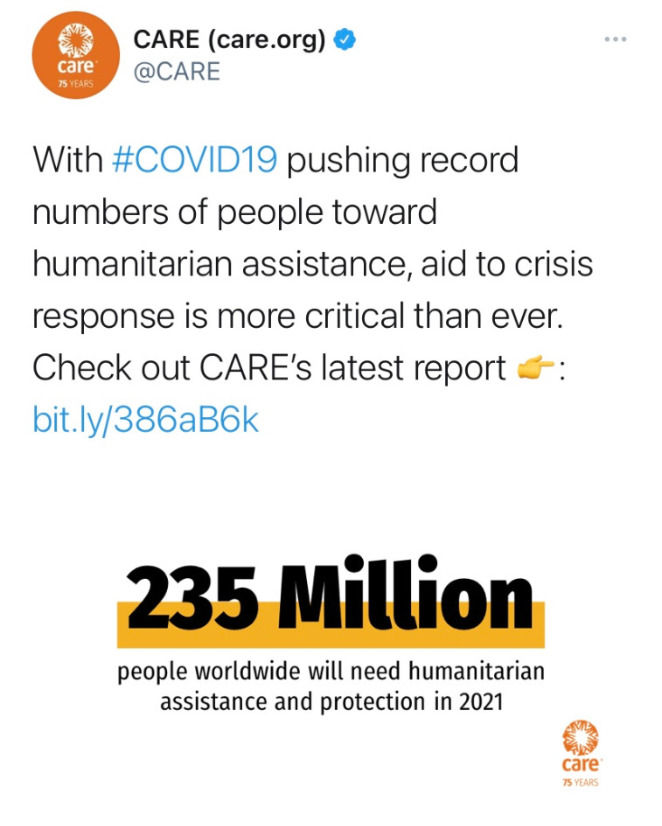
Delphine Pinault expressed her deep concern for the funding cuts and speaks on how this will have a large-scale impact on the different communities. She said:
“If we’re looking strictly at Covid, for example, no one is safe until everybody is safe and this type of attitude of donors is not only short sighted, but its actually very risky even for overall global peace and stability. If people are not able to meet their basic needs because of these significant cuts in donor money, the risk of conflict increase, conflict over natural resources, the risk of migration, which many donors of course also do not want to see happen in their own countries.
“If you look at the trillions of dollars that are being invested today in our own economies and the rescue packages and if we’re able to put this type of resources on the table for our own people then we should be able to. It’s a matter of political winner really, not that the money is not there, we should be able to do that as well to support developing countries who need our help, probably more than ever before.”
Additionally, when asked what her current and future concerns are for humanitarian and development issues are, she referred back to funding cuts. She said:
“We are really calling on donors to continue to fund the humanitarian response plans. We see a growing gap between humanitarian needs and the funding levels.
“The needs have never been so high before, so it’s really that gap that needs to be closed.”
Pinault highlighted how the pandemic has exposed other issues, that of course they were aware of, but now it’s became more evident and this exposure will play as a positive role for the future of humanitarian organisations. Pinault said:
“I think one of the benefits has been that, and not just for CARE, I think the broader humanitarian community, is the value of local partners was made really more evident than ever before.
“We know women’s organisations on the ground often know best – what affected women need. But I think the pandemic made us realise, as we were less able to be present on the front lines of the response ourselves because of all the measures. It made us really take full conscious of the vital role of local actors.”
Healthcare Services in Developing Nations:
Many developing countries lack adequate healthcare services and some of these facilities may be unstable. For example, South Sudan has a population of 11 million and only four ventilators. The Central African Republic has three ventilators. There is fewer than 2,000 working ventilators that should serve hundreds of millions of people across 41 African counties, in comparison to more than 170,000 in America. With coronavirus being a respiratory disease, the lack of equipment that could potentially save someone’s life is extremely vital, potentially more than ever.
Pinault highlights the crucial need for better healthcare services and spoke about how many healthcare workers in developing countries are limited in how they can help people, as she said that many have not been paid properly or at all for a long time and she described these worker as “heroes.” She also added:
“They were really trying to help people, but they do not have access to personal equipment protection. I think what we have also seen with this pandemic is that at a multilateral state level, we are not always succeeding and responding as one global community. At an individual level, there has been, particularly in the health sector with doctors, nurses and health personnel, trying to do their best in some of the most challenging circumstances. I think that’s probably the part that at least gives me a lot of hope, we have not lost our humanity.”


Comments